
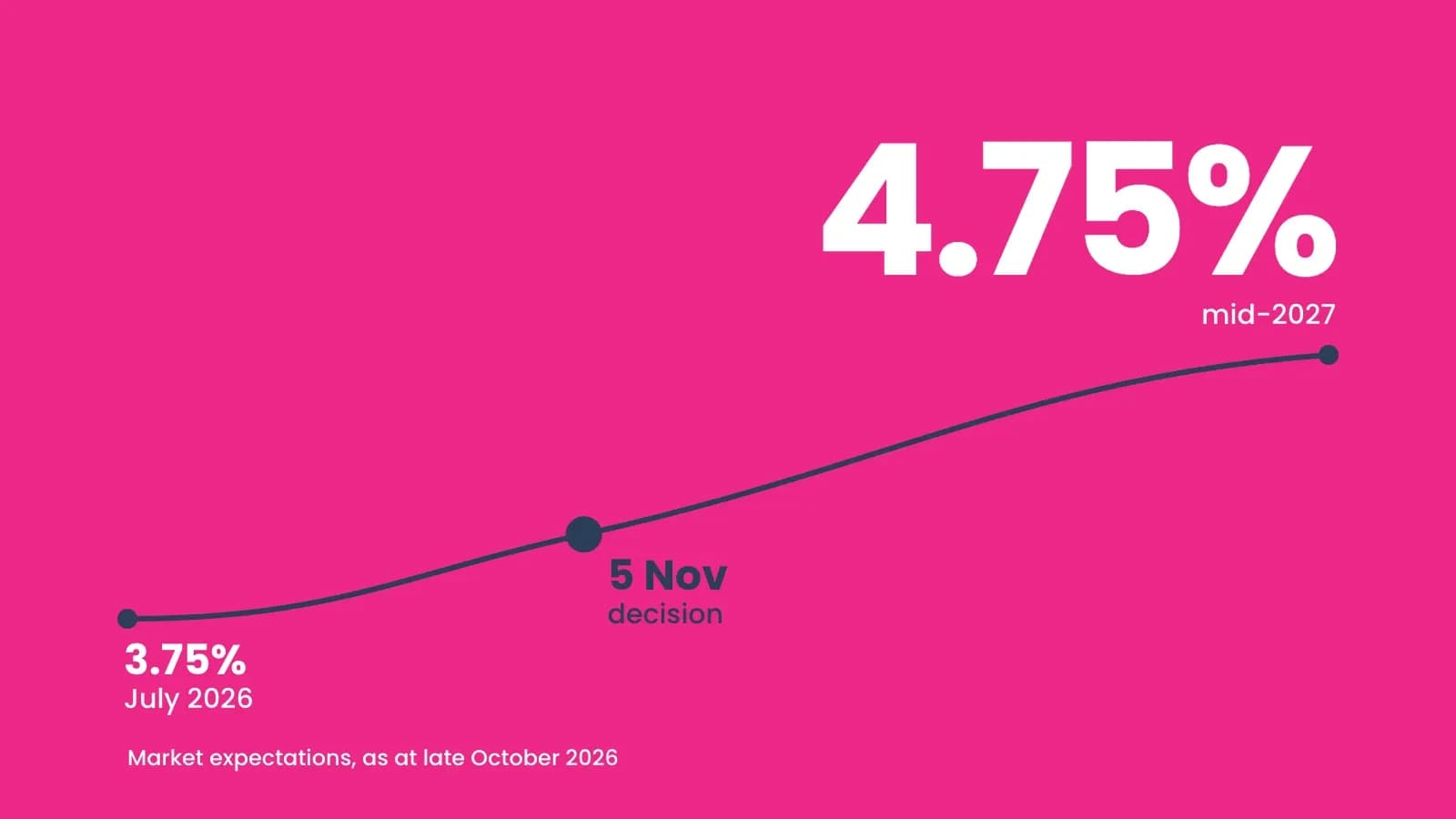
Three members voted to raise. The market now expects 4.75%.
Inflation is forecast above 4%, most economists expect a rise on 5 November, and markets are pricing Bank Rate at 4.75% by mid-2027. On a bridging or development file that is an exit problem before it is a pricing problem.

This one did not come from the Budget. It came from the economic picture sitting behind it, and for anyone with a bridge or a development facility it matters more than any tax measure announced on Budget day.
In July, the Monetary Policy Committee held Bank Rate at 3.75% and we wrote that the interesting part was not the hold. It was that three members voted to raise. Three months on, those three look less like dissenters and more like the leading indicator.
Where expectations have moved to
As at the week before the Budget, the position was this.
A full point of repricing in market expectations over seven months is a significant move. It has happened quietly, while attention was on the Budget.
Why this is an exit problem, not a pricing problem
The instinct is to read a rate rise as a cost of borrowing story. On short-term property lending that is the smaller half of it.
A bridge is underwritten on the exit. A development facility is underwritten on the proposition that units sell, at a price, within a period. Both of those assumptions are rate-sensitive in ways the headline facility rate is not.
We have written before that stated intention is no longer an exit strategy and that lenders want comparables, appraisals and evidence. Add this: an exit pack built against a rate path that has since moved a point is evidence of the wrong thing.
What to stress test against
If you hold a facility that matures in the next eighteen months, the useful exercise is short.
Extensions: the conversation is cheaper in November than in March
A facility running short of term is a manageable problem if it is raised early and an expensive one if it is raised late. Lenders have far more room when a borrower comes to them four months out with a revised plan than when the same borrower comes four weeks out with a problem.
That gap widens when rates are rising, because the lender is also repricing. The borrower who opened the conversation in November is being quoted against a book the lender has had time to plan. The borrower who opens it in March is being quoted against whatever is left.
Figures above reflect market and economist expectations as reported in the week before the Budget. Expectations move. The MPC decision on 5 November will reset the picture and we will cover it.
“Three of nine voted to raise in July and the market has since repriced by a full point. Nobody should be modelling an exit on 3.75% money. If your facility matures inside eighteen months, rerun it at 4.75% this week and find out whether you have an exit or a hope.”